Europe from the 11th to the 15th centuries: from fields to cathedrals
Agriculture and trade, guilds, cities, universities, monarchies, the 14th-century crisis and Gothic art.
1. Agricultural and commercial expansion
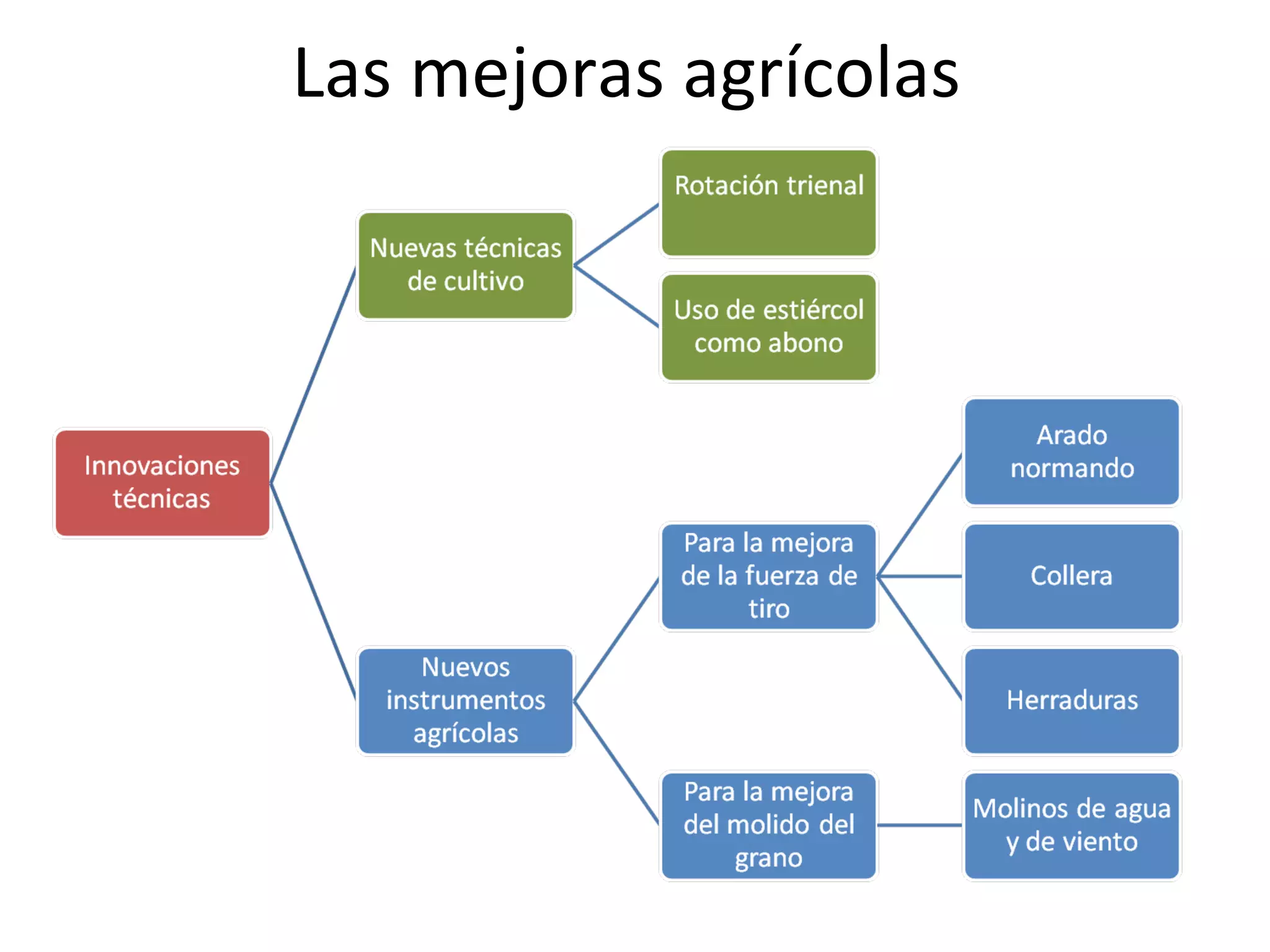
More food, more people, more exchanges. Keys: mouldboard plough, three-field rotation, irrigation, mills; fairs, routes and banking.

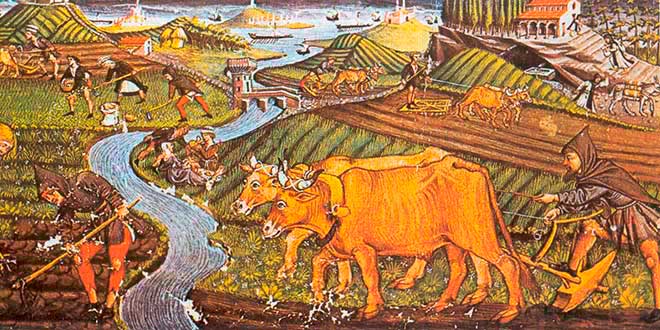
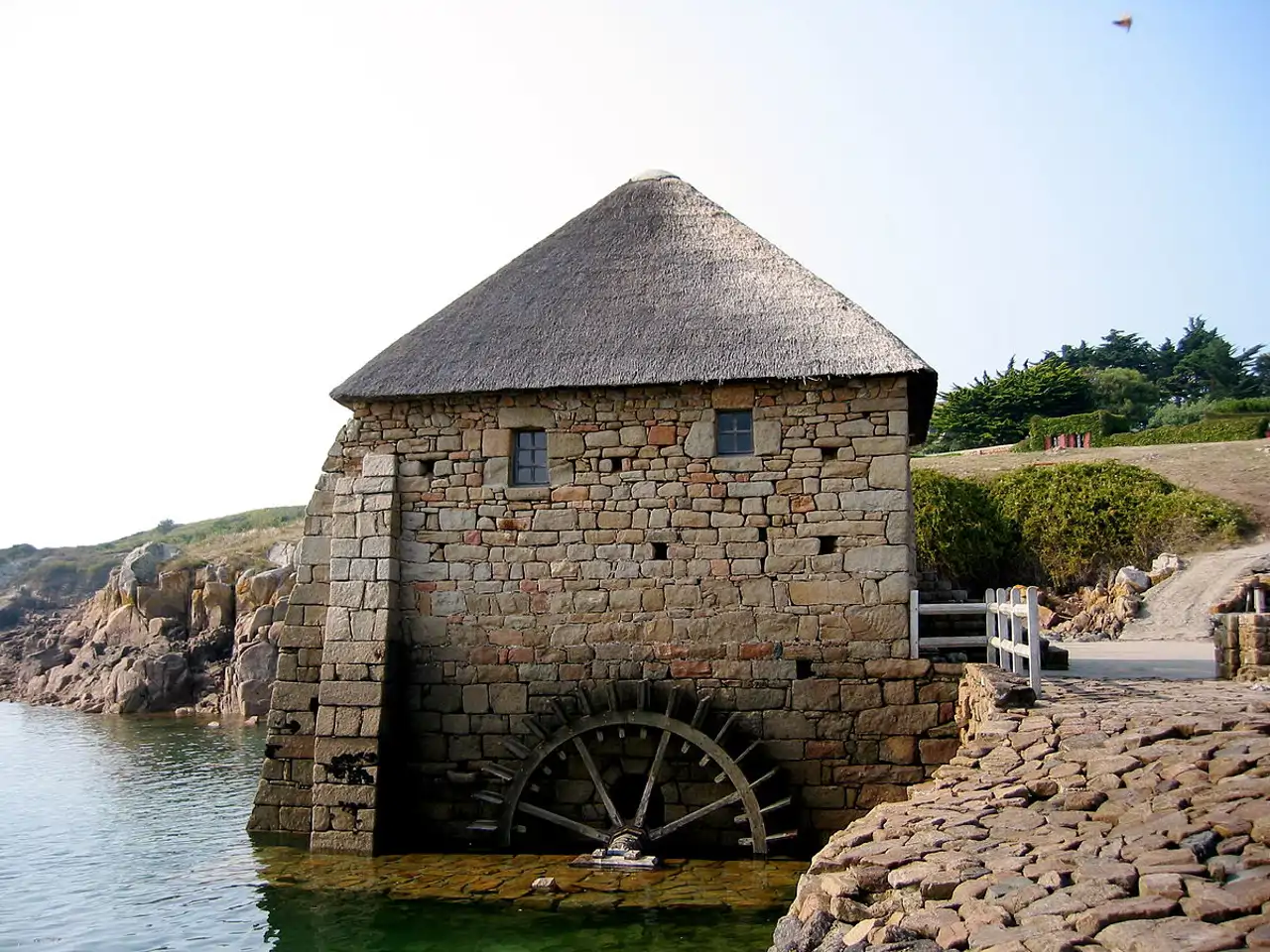
- Innovations: mouldboard plough · three-field rotation · water/wind mills · irrigation ⇢ more production.
- European population: approx. 42 M (year 1000) → 73 M (1300).
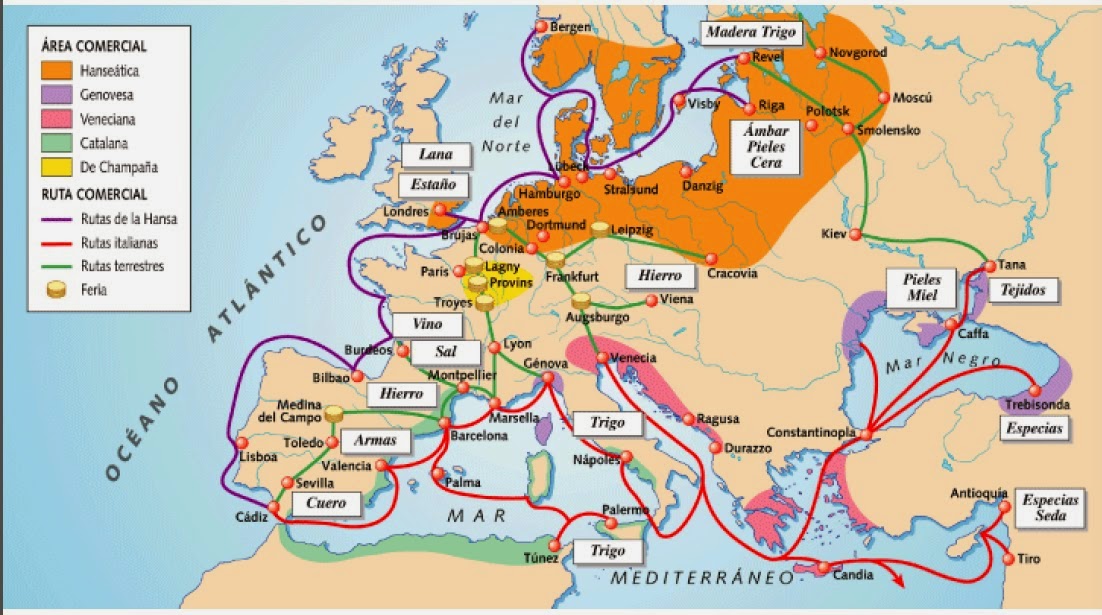
- Interregional trade: Mediterranean · Atlantic/Baltic routes; fairs (Champagne).
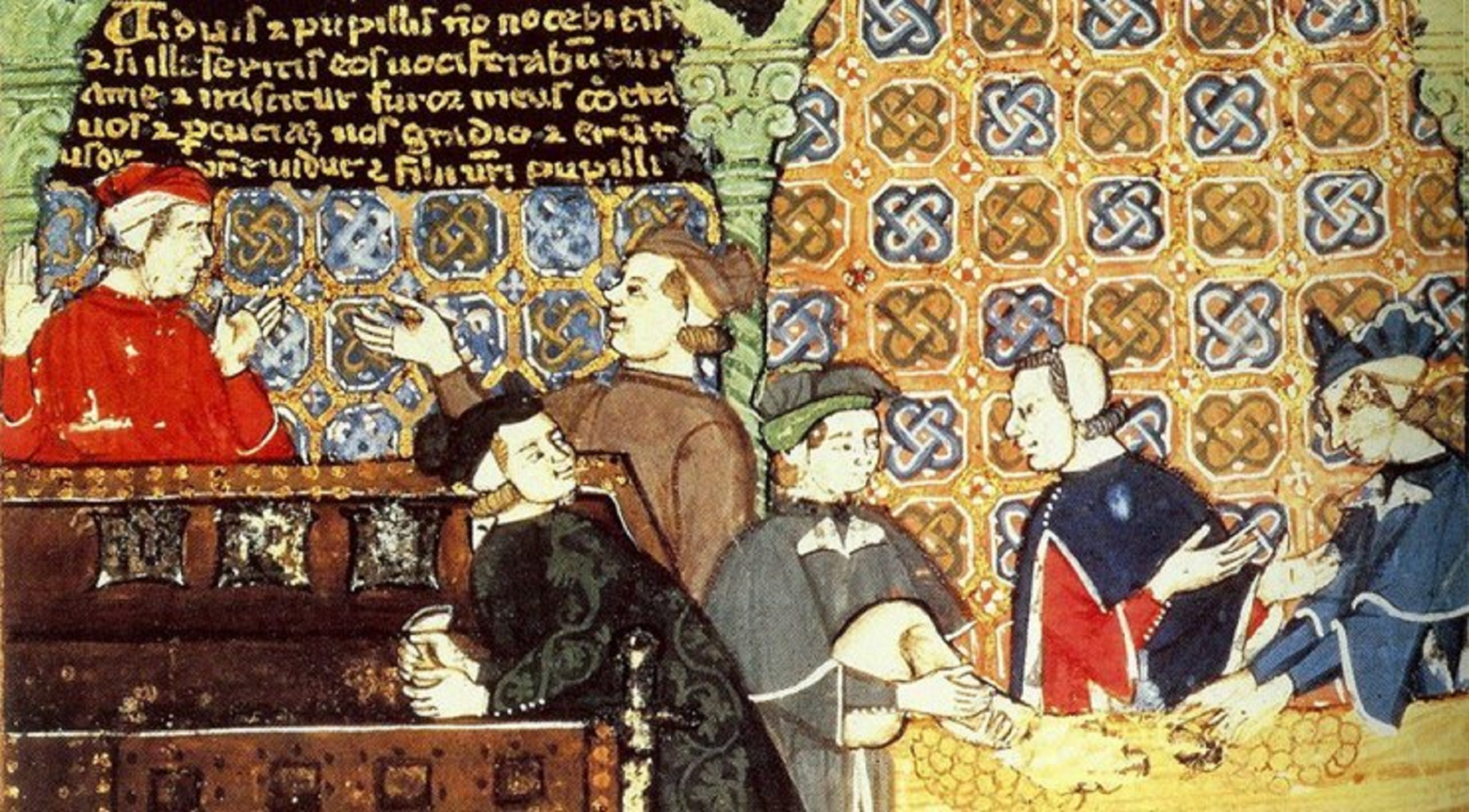
- New features: credit, money changers ⇒ banking and bills of exchange.

Letter from a Florentine merchant (c. 1290):
“I am sending you, on the Pisa ship, ten sacks of English wool and two bales of Flemish cloth, which you will sell in Genoa at the best price you can. If prices rise, keep the goods until the fair of San Remo. Send me in return pepper, ginger and sugar, which sell dearly here.”
Pedagogical adaptation of original source: Archivio di Stato di Firenze, Lettere di mercanti, vol. II, letter from Guido di Riccio to Piero di Cambio, c. 1290. (Modern translation adapted from medieval Italian)
Excerpt from a bill of exchange contract (1253):
“I, Pietro Baldovini, merchant of Florence, declare that I have received from Ugo di Bene seventeen Tours pounds on loan, which I shall repay in Genoa within three months, at the going exchange rate in that market.”
Original source: Archivio di Stato di Firenze, Fondo Notarile, Atti di cambio, year 1253. Quoted in: Raymond de Roover, The Rise of Banking in Medieval Florence (Cambridge, 1963), p. 47.
Objective: Connect economic history with critical thinking. Activity: Choose a medieval product (wool, wine, salt, pepper, silk). Research where it came from, who produced it and where it was exported. Present it with a commercial label or “medieval product” info card. Bonus: present it in a “medieval classroom fair”.

2. Development of crafts (guilds)
Trades are organised into guilds. Career path: apprentice → journeyman → master. Quality, prices and mutual aid.
Quick guild overview
- Master: owner of the workshop and tools.
- Journeyman: skilled worker with wages.
- Apprentice: learns without pay; lives with the master.
- Control: raw materials · quality · price · support for members.
Guild concept map


3. Medieval urban life
Cities are reborn: trade, freedom and self-government (charter and council). Key spaces: walls, square and cathedral.
- Urban society: mercantile and artisan elites · majority of workers · poor/marginalised people.
- Religious diversity: Christians, Jews (aljamas) and Muslims (morerías).
- Council/town hall: security, taxes, walls.
Fuero of Sepúlveda (11th century, confirmed by Alfonso VI in 1076):
“No neighbour of Sepúlveda shall be forced to go to war beyond the pass of Somosierra, except by order of the king. If anyone commits homicide, he shall pay one hundred sueldos to the relative of the dead man, and if he does not have them, let him be banished. Whoever comes to settle in Sepúlveda shall have house and garden free from all tribute for ten years.”
Source: Fuero of Sepúlveda
Fuero of Soria (year 1202, granted by Alfonso VIII of Castile):
“We command that every neighbour of Soria has the right to sell and buy freely in the market, without paying any toll or grazing tax. If any outsider is wronged within the town, the council shall grant him swift justice. And every man who comes to live in Soria shall be considered free and not a serf, from the day he establishes his household.”
Source: Fuero of Soria, promulgated by Alfonso VIII in 1202.
Activity: commentary on a historical text (Fuero of Sepúlveda)
1. Initial reading of the text
Silent and aloud reading of the fuero excerpt.
2. Guided questions for the commentary
A. Identifying the source
- What type of text is it? Choose and justify in one sentence:
- a) Narrative
- b) Legal
- c) Religious
- When was it drafted or confirmed?
- Who confirms or authorises it?
- Which town or community is it addressed to?
B. Literal understanding of the content
(Highlight or briefly copy)
- According to the text, who does NOT have to go to war beyond Somosierra?
- What punishment is laid down for homicide? (Two options)
- What advantages do those who move to Sepúlveda have?
C. Historical analysis
- This text is a fuero. What do you think fueros were for in the Middle Ages?
(Hint: protect settlers…) - Why do you think the king wanted to attract inhabitants to Sepúlveda in the 11th century?
(Hint: repopulation…) - What does this text tell us about life in a medieval town?
(Hint: taxes, need for rules…)
D. Link with the topic of the “medieval urban rebirth”
The fueros helped cities grow. Explain one way in which this fuero could have favoured the urban development of Sepúlveda.
(Example: tax exemptions → new settlers arrive…)
3. Final activity: mini-summary
Ask them to complete: “This fuero is important because…” (2–3 lines).
4. Optional extension (for pair work)
We compare the two fueros:
- Which rules are similar?
- Which one seems stricter?
- What does it tell us about medieval society?


4. Universities and culture
Urban schools give rise to universities. Faculties: Arts, Medicine, Law, Theology. Method: reading + debate.
- Liberal Arts: grammar, rhetoric, logic, arithmetic, music, geometry, astronomy.
- Degrees: bachelor · licentiate · doctor.
- Mendicant orders: Franciscans and Dominicans.
- Literature: epics, lyric poetry; Romance languages.
5. Strengthening of royal power
Taxes, armies and Roman law strengthen monarchies. Cortes/Parliaments support expenses and taxes.
How does the king gain power over the nobility?
Three reinforcing pathways: MONEY · CITIES · LAW
More trade and more towns ⇒ more wealth in the kingdom.
The monarch collects more money than before.
With this money, the king pays for a royal army (less dependent on nobles).
If a noble rebels, the king has his own soldiers to enforce his authority.
The bourgeoisie appears (merchants, bankers, wealthy artisans).
The king grants charters (privileges) to cities if they support him.
The king gathers nobles, clergy, and cities to approve taxes and expenditures.
The bourgeoisie prefers a strong king (one single law) over many feudal lords.
Experts in law are trained, recovering Roman law.
It defends a superior power that enforces the law ⇒ the king gains legal authority.
Officials (many of them bourgeois) collect taxes, judge, and govern on behalf of the king.
The king expands his territories (wars, marriages, recovery of fiefs). France, England, Castile, Aragon, and Portugal are strengthened.


Letter attributed to Joan (1429, adaptation):
“King of England, and you, Duke of Bedford, who call yourself regent of the kingdom of France; Guillaume de la Poule, Earl of Suffolk; John, Lord Talbot; and you, Thomas, Lord Scales, who call yourselves lieutenants of the Duke of Bedford: Do justice to the King of Heaven. Hand over to the Maid, sent by God, the king of heaven, the keys of all the good cities that you have taken and violated in France. She is ready to make peace if you wish to, provided that you restore France and pay for what you have occupied. And if you do not, know well that she is head of the armies and will drive you out of France, whether you wish it or not, and will cause great destruction. Joan the Maid.”
(Pedagogical recreation)
Letter from Henry II of England to his rebel barons (1173):
“We, Henry, by the grace of God King of England, order that all our vassals be loyal and faithful to us, as their oath commands. For some, forgetting their duty, have taken up arms against their natural lord. Remember that justice and law spring from the king’s power, and not from the will of each lord. Whoever does not obey this order shall be held a traitor to the kingdom and to God.”
Authentic document, preserved in the Royal Rolls of the British National Archives (The National Archives, UK — Patent Rolls). Historical context: In the Revolt of the Barons (1173–1174), English nobles, supported by the king’s own sons, rose up against Henry II because he wanted to limit their power and subject them to royal justice. It was one of the first major clashes between the monarchy and the feudal nobility. The king defends his authority against the barons, who tried to act independently. It shows the transition towards a stronger, more centralised monarchy, a typical feature of the High Middle Ages. Henry II tried to impose equal justice for everyone, including the nobles.
“Las Siete Partidas” of Alfonso X the Wise (Partida II, Title I, Law X. c. 1265)
“The king is placed on earth in God’s place to uphold justice and truth. And therefore, he must have power over all, and there must be no one greater within his lordship. For royal power cannot be divided or diminished without harm to the kingdom.”
(Pedagogical recreation)
“Constitutions of Melfi” (1231). Frederick II of Hohenstaufen, emperor of the Holy Roman Empire and king of Sicily
“Justice must proceed solely from the king, and no one may exercise it without his command. All judges and officers of the kingdom shall receive their authority from Us, and shall answer to Us for their actions. No noble shall raise armies, nor hold fortresses, without the consent of the king. Thus shall peace and unity be preserved in the kingdom, under one power and one law.”
(Pedagogical recreation)

- Major monarchies: France, England, Portugal, Castile and Aragon.
- Causes of conflicts: successions, borders, rebellious nobles; Western Schism.
6. The 14th-century crisis
Agricultural stagnation, wars and revolts. The Black Death (1347–1352) causes millions of deaths and persecutions.
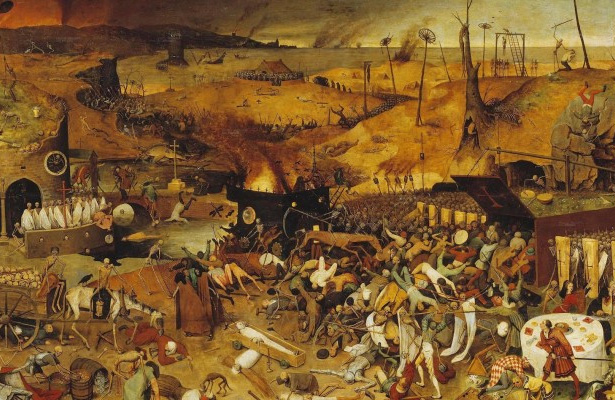


- 🌧️ Rains and floods ⇒ bad harvests ⇒ high prices.
- 🪧 Revolts: jacqueries (France), 1381 (England), irmandiños (Galicia).
- ☠️ Plague: 1347–1352, greatest impact on cities and trade routes.
7. Gothic architecture
Cathedrals as the image of the city. Height, light and technique: pointed arch, ribbed vault, flying buttresses.


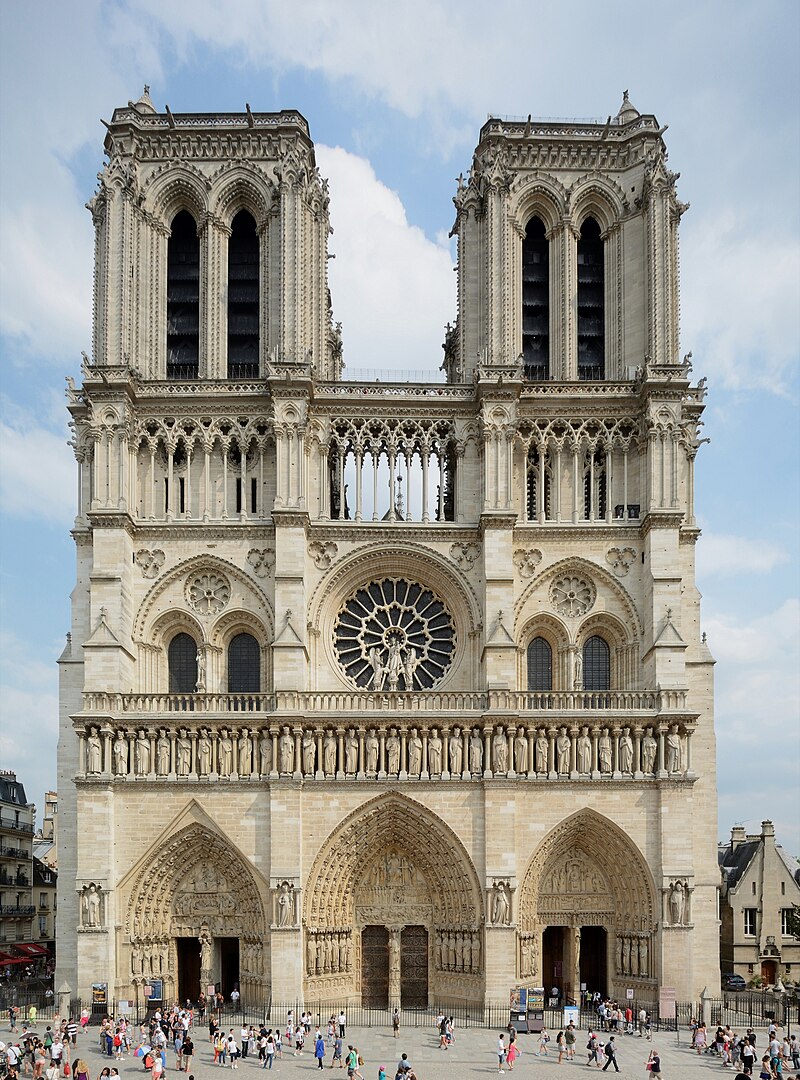
- Thin, high walls · large windows · rose window.
- Structure: pointed arch · ribbed vault · flying buttresses/buttresses.
- Plan: wider, higher central nave; polygonal apse.
8. Gothic sculpture and painting
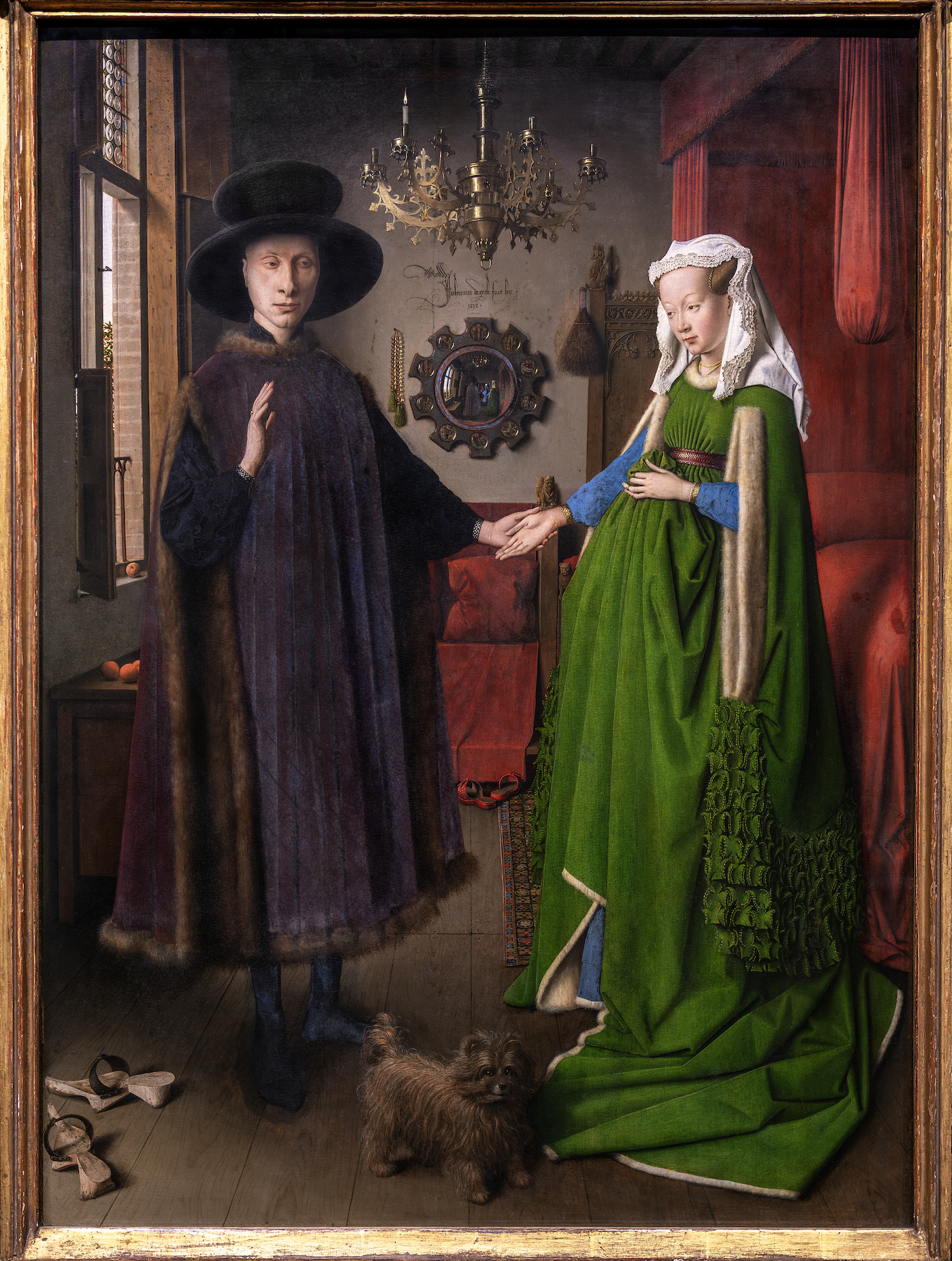
Humanisation and movement. Polychromy, portraits of elites. Miniature and altarpiece; in Flanders, oil painting emerges.

9. Interactive activities
Review by playing. You can use a phone, tablet or interactive whiteboard.


Fuero de León · Lectura y análisis

Lectura guiada · Contexto histórico · Análisis crítico
Abrir actividades del Fuero de León
a. THE CATHEDRAL'S LOOK · IF STONES COULD TALK
I am the Pulchra Leonina. I see, I listen, patient, still. Great and immaculate they built me. Human masters with almost divine hands. From the bloodied earth, now redeemed by sword, I rise with spires that reach for the sky. I am the one that bonds the human and the divine. Both I know, and of the first I will tell you, for that in human deeds there is certainty that eases the path ahead. This is what I saw, this is what I heard.
b. LEÓN, PIONEERING THE URBAN RENAISSANCE IN THE HIGH MIDDLE AGES
El fuero de León y la Curia Regia que dio lugar al primer parlamento europeo.
Preguntas de respuesta lectora
- Sobre el contexto histórico del documento:
¿Por qué crees que el rey Alfonso V considera que la situación de su reino es de caos y anarquía? ¿Qué amenazas externas e internas menciona y cómo justifican su decisión de otorgar un fuero? - El rey Alfonso V busca repoblar León tras su devastación. ¿Por qué era tan importante la repoblación para los reyes medievales? ¿Qué estrategias usa el fuero para atraer nuevos habitantes?
- Sobre las medidas del Fuero de León:
Los campesinos de behetría pueden elegir señor y llevarse sus bienes. ¿Por qué era esto importante para el rey? ¿Cómo afectaba a la sociedad feudal? - Los jueces serán elegidos por el rey. ¿Qué ventajas tiene para la población? ¿Qué intención política puede haber detrás?
- Normas sobre mercados y protección a comerciantes y consumidores. ¿Por qué era tan importante el mercado en la sociedad medieval? ¿Por qué se castigaba a quien lo alteraba?
- Se prohíbe que funcionarios del rey entren en una casa sin permiso. ¿Qué derechos protege esta norma? ¿Por qué era importante garantizarlos?
- Sobre normas sociales y económicas:
¿Por qué se castiga falsear el peso del pan o la carne? ¿Qué relación tiene con la justicia económica? - Las mujeres no pueden ser apresadas si sus maridos están ausentes. ¿Qué revela esta norma sobre el papel y derechos de las mujeres?
- El fuero regula impuestos y relaciones económicas entre habitantes y rey. ¿Qué medidas evita abusos? ¿Por qué es clave para la paz social?
- Sobre justicia y castigos:
¿Por qué las leyes medievales imponían castigos tan duros? Ventajas y desventajas de este tipo de justicia. - Homicida que huye y no es capturado en nueve días puede volver sin castigo. ¿Por qué incluir esta norma? ¿Qué revela sobre la justicia medieval?
- Sobre organización política y social:
Diferencias entre campesinos libres, de señorío y nobles. ¿Qué intenta lograr el rey con dichas diferencias? - Creación de un concejo para gestionar asuntos locales. ¿Por qué ceder poder al concejo y no a los nobles?
- Reflexión final:
Si fueras campesino en 1017, ¿qué normas te beneficiarían y cuáles te perjudicarían? - ¿Qué valores transmite Alfonso V con el fuero? ¿Te parecen justas sus medidas? ¿Por qué?
- Compara el Fuero de León con leyes actuales: similitudes, diferencias y normas que podrían aplicarse hoy.
- ¿Qué medidas del fuero fueron decisivas para fortalecer León y evitar nuevas conquistas?



0 Comentarios